
Plan for 'space hotel' unveiled
www.bbc.co.uk
A Russian firm has launched an ambitious plan to put a "cosmic hotel" into orbit by 2016, a Russian news agency reports.

Russian Company Orbital Technologies Plans Luxury Space Hotel
www.aolnews.com
(Sept. 30) -- A Russian company is aiming to take the lead in the latest market for luxury hotels: outer space. Orbital Technologies has unveiled plans for its celestial hotel, which would let guests enjoy the thrill of space travel without having to endure the spartan conditions of life on the International Space Station.

www.energia.ruThe Universal Space Platform was developed by S.P. Korolev RSC Energia within the Yamal project. It has gone flight qualification as a part of the Yamal-100 communication satellite launched on September 6, 1999.

Russian Federal Space Agency - Roscosmos |
www.roscosmos.ru

Russian Federal Space Agency - Roscosmos | News
www.federalspace.ru
Russian Prime Minister Vladimir Putin said on Tuesday that the government will spend 115 billion rubles ($3.8 bln) on national space programs in 2011.

Galactic Suite
www.galacticsuite.com
Galactic Suite es una compañía privada de turismo espacial que está desarrollando el primer hotel en el espacio, combinando elementos en órbita y en tierra para ofrecer una experiencia completa de turismo espacial.

Galactic Suite
galacticsuitespaceresort.com
Galactic Suite es una compañía privada de turismo espacial que está desarrollando el primer hotel en el espacio, combinando elementos en órbita y en tierra para ofrecer una experiencia completa de turismo espacial.

Fly2Stars - Space Tourism , Tourism in Space, Virgin Galactic
www.fly2stars.com
Space tourism is the next phase in the evolution of humanity, tourism in Space will be available to all in the coming years and we are ready to bring you all the space tourism information & provide info on commercial space flights such Virgin Galactic.

Vacation aboard planned space hotel to cost $1 million [video] | SmartPlanet
www.smartplanet.com
Orbital Technologies has just released detailed designs for a Commercial Space Station AKA the space hotel.

Russia's $165,000 per night space hotel - The Week
theweek.com
Russia may have come in second in the race to the moon, but it plans on being first in the race for boutique space hotels.

Commercial Space Station: Russian firm Orbital Technologies reveals hotel plans
www.dailymail.co.uk
Russia yesterday announced plans for a hotel in orbit 217 miles up which would house seven guests in four cabins and have huge windows for views of the Earth.

Images of the Commercial Space Station

Russia allocates $3.8 bln for space programs in 2011
en.rian.ru
Russian Prime Minister Vladimir Putin said on Tuesday that the government will spend 115 billion rubles ($3.8 bln) on national space programs in 2011.
Orbital Technologies Commercial Space Station
The Orbital Technologies Commercial Space Station is an orbital space station intended for commercial clients. The station was recently proposed by Orbital Technologies, a Russian aerospace firm, who is collaborating to develop the station with Rocket and Space Corporation Energia (RSC Energia).
The station would consist of a single module of approximately 3 metres (9.8 ft) diameter with a usable volume of about 20 m3 (710 cu ft).
As of November 2010[update], the company is "looking to launch in the next five years or so," ... "in 2015 or 2016."
Several customers are already "under contract from the commercial space industry and the scientific community interested in areas such as medical research, protein crystallization, and materials processing, as well as from the geographic imaging and remote-sensing industry. Media projects have also been proposed. The biggest goal may be tourism."
The station is receiving support from the Russian Federal Space Agency, who is also encouraging private participation. It is hoped the station "will attract private investment for the Russian space industry."
The station "will be serviced by Russian Soyuz and Progress spacecraft and potentially other commercially available vehicles."
 Logo of Roscosmos | |
| Established | 1992 (formerly the Soviet space program, 1922-1991) |
|---|---|
| Headquarters | Moscow |
| Primary spaceport | Baikonur Cosmodrome Plesetsk Cosmodrome |
| Administrator | Vladimir Popovkin |
| Budget | 115 billion RUB ($3,8 billion) (2011) |
Space industry of Russia
Soviet OKB (if applicable) | New organization | Ownership | Notable products |
|---|---|---|---|
| Korolev | RKK Energia | private | |
| NPO Lavochkin | |||
| NPO Mashinostroyeniya | |||
| NPO Energomash | |||
| Khrunichev | state | ||
| TsSKB-Progress | state | ||
| NPO Molniya | |||
| NPO PM | |||
| NPO Polyot | |||
| MKB Raduga | |||
| Kuznetsov | |||
| Khimavtomatika | |||
| Makeyev | |||
| JSC Khartron | private | ||
| Moscow Institute of Thermal Technology | |||
| related Ukrainian organizations: | |||
| Yuzhnoye Design Bureau | |||
| Makarov | Yuzhmash | ||
Historic Russian space gallery
People

Sergey Korolyov was the mastermind behind the first satellite, first human in orbit and first spacewalk.

The first human in space and to orbit the Earth, Yuri Gagarin.

Cosmonaut Aleksei Leonov, the first person to perform an EVA (spacewalk), in 1965.
Spacecraft
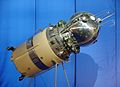
Vostok was the first spacecraft to carry a human being in space
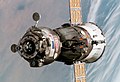
Soyuz is the longest serving manned spacecraft design in history (1967– ) , upgraded regularly

Progress is the longest serving unmanned cargo spacecraft (1978– )

First permanently manned space station, the Soviet/Russian Mir, which orbited the Earth from 1986 until 2001
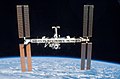
Russia and the US are the main partners of the International Space Station (ISS).

The Soviet space program produced the canceled Space Shuttle Buran based on the discontinued Energia launcher.
Launch vehicles

Soyuz rockets are responsible for launching all Soyuz and Progress spacecraft into space

Proton rockets are the heavylift workhorse of Russian space industry
When completed in late 2011, the ISS will consist of sixteen pressurised modules with a combined volume of around 1,000 cubic metres (35,000 cu ft). These modules include laboratories, docking compartments, airlocks, nodes and living quarters. Fifteen of these components are already in orbit, with the remaining one awaiting launch. Each module was or will be launched either by the Space Shuttle, Proton rocket or Soyuz rocket.
| Module | Assembly mission | Launch date | Launch system | Nation | Isolated view | Notes |
|---|---|---|---|---|---|---|
| Zarya (lit. dawn) (FGB) | 1A/R | 20 November 1998 | Proton-K | Russia (builder) USA (financier) |  | |
| The first component of the ISS to be launched, Zarya provided electrical power, storage, propulsion, and guidance during initial assembly. The module now serves as a storage compartment, both inside the pressurised section and in the externally mounted tanks which hold over 5.4 tons of fuel. | ||||||
| Unity (Node 1) | 2A | 4 December 1998 | Space Shuttle Endeavour, STS-88 | USA |  | |
| The first node module, connecting the American section of the station to the Russian section (via PMA-1), and providing berthing locations for the Z1 truss, Quest airlock, Destiny laboratory, Tranquility node and the PMM Leonardo. | ||||||
| Zvezda (lit. star) (service module) | 1R | 12 July 2000 | Proton-K | Russia |  | |
| The station's service module, which provides the main living quarters for resident crews, environmental systems and attitude & orbit control. The module also provides additional docking locations for Soyuz spacecraft, Progress spacecraft and the Automated Transfer Vehicle, and its addition rendered the ISS permanently habitable for the first time. | ||||||
| Destiny (U.S. laboratory) | 5A | 7 February 2001 | Space Shuttle Atlantis, STS-98 | USA |  | |
| The primary research facility for United States payloads aboard the ISS, Destiny is intended for general experiments. The module houses 24 International Standard Payload Racks, some of which are used for environmental systems and crew daily living equipment. Destiny also serves as the mounting point for most of the station's Integrated Truss Structure. | ||||||
| Quest (joint airlock) | 7A | 12 July 2001 | Space Shuttle Atlantis, STS-104 | USA |  | |
| The USOS airlock, Quest hosts spacewalks with both United States EMU and Russian Orlan spacesuits. Quest consists of two segments; the equipment lock, that stores spacesuits and equipment, and the crew lock, from which astronauts can exit into space. This module has a separately controlled atmosphere. Crew sleep in this module, breathing a low nitrogen mixture the night before scheduled EVAs, to avoid decompression sickness (known as "the bends") in the low pressure suits. | ||||||
| Pirs (lit. pier) (docking compartment) | 4R | 14 September 2001 | Soyuz-U, Progress M-SO1 | Russia |  | |
| Pirs provides the ISS with additional docking ports for Soyuz and Progress spacecraft, and allows egress and ingress for spacewalks by cosmonauts using Russian Orlan spacesuits, in addition to providing storage space for these spacesuits. | ||||||
| Harmony (node 2) | 10A | 23 October 2007 | Space Shuttle Discovery, STS-120 | Europe (builder) USA (operator) |  | |
| The second of the station's node modules, Harmony is the utility hub of the ISS. The module contains four racks that provide electrical power, bus electronic data, and acts as a central connecting point for several other components via its six Common Berthing Mechanisms (CBMs). The European Columbus and Japanese Kibō laboratories are permanently berthed to the module, and American Space Shuttle Orbiters dock with the ISS via PMA-2, attached to Harmony's forward port. | ||||||
| Columbus (European laboratory) | 1E | 7 February 2008 | Space Shuttle Atlantis, STS-122 | Europe |  | |
| The primary research facility for European payloads aboard the ISS, Columbus provides a generic laboratory as well as facilities specifically designed for biology, biomedical research and fluid physics. Several mounting locations are affixed to the exterior of the module, which provide power and data to external experiments such as the European Technology Exposure Facility (EuTEF), Solar Monitoring Observatory, Materials International Space Station Experiment, and Atomic Clock Ensemble in Space. A number of expansions are planned for the module to study quantum physics and cosmology. | ||||||
| Kibō Experiment Logistics Module (lit. hope and wish JEM–ELM) | 1J/A | 11 March 2008 | Space Shuttle Endeavour, STS-123 | Japan |  | |
| Part of the Kibō Japanese Experiment Module laboratory, the ELM provides storage and transportation facilities to the laboratory with a pressurised section to serve internal payloads. | ||||||
| Kibō Pressurised Module (JEM–PM) | 1J | 31 May 2008 | Space Shuttle Discovery, STS-124 | Japan |  | |
| Part of the Kibō Japanese Experiment Module laboratory, the PM is the core module of Kibō to which the ELM and Exposed Facility are berthed. The laboratory is the largest single ISS module and contains a total of 23 racks, including 10 experiment racks. The module is used to carry out research in space medicine, biology, Earth observations, materials production, biotechnology, and communications research. The PM also serves as the mounting location for an external platform, the Exposed Facility (EF), that allows payloads to be directly exposed to the harsh space environment. The EF is serviced by the module's own robotic arm, the JEM–RMS, which is mounted on the PM. | ||||||
| Poisk (lit. 'search') (mini-research module 2) | 5R | 10 November 2009 | Soyuz-U, Progress M-MIM2 | Russia |  | |
| Poisk is the second Russian airlock for spacewalks, almost identical to Pirs, but lacking Strela cargo cranes. It is one of the four main Russian docking ports for Soyuz and Progress spacecraft, and is used as an interface for scientific experiments. | ||||||
| Tranquility (node 3) | 20A | 8 February 2010 | Space Shuttle Endeavour, STS-130 | Europe (builder) USA (operator) |  | |
| The third and last of the station's U.S. nodes, Tranquility contains an advanced life support system to recycle waste water for crew use and generate oxygen for the crew to breathe. The node also provides four berthing locations for more attached pressurised modules or crew transportation vehicles, in addition to the permanent berthing location for the station's Cupola. | ||||||
| Cupola | 20A | 8 February 2010 | Space Shuttle Endeavour, STS-130 | Europe (builder) USA (operator) |  | |
| The Cupola is an observatory module that provides ISS crew members with a direct view of robotic operations and docked spacecraft, as well as an observation point for watching the Earth. The module comes equipped with robotic workstations for operating the SSRMS and shutters to protect its windows from damage caused by micrometeorites. It features a 80-centimetre (31 in) round window, the largest window on the station. | ||||||
| Rassvet (lit. dawn) (mini-research module 1) | ULF4 | 14 May 2010 | Space Shuttle Atlantis, STS-132 | Russia |  | |
| Rassvet is being used for docking and cargo storage aboard the station. | ||||||
| Leonardo (Permanent Multipurpose Module) | ULF5 | 24 February 2011 | Space Shuttle Discovery, STS-133 | Italy (Builder) USA (Operator) |  | |
| The Leonardo PMM houses spare parts and supplies, allowing longer times between resupply missions and freeing space in other modules, particularly Columbus. The PMM was created by converting the Italian Leonardo Multi-Purpose Logistics Module into a module that could be permanently attached to the station. The arrival of the PMM module marked the completion of the United States Orbital Segment. | ||||||
Launch schedule
| Module | Assembly mission | Launch date | Launch system | Nation | Isolated view | Notes |
|---|---|---|---|---|---|---|
| Nauka (lit. 'science') (Multipurpose Laboratory Module) | 3R | May 2012 | Proton-M | Russia |  | |
| The MLM will be Russia's primary research module as part of the ISS and will be used for general microgravity experiments, docking, and cargo logistics. The module provides a crew work and rest area, and will be equipped with a backup altitude control system that can be used to control the station's altitude. Based on the current assembly schedule, the arrival of Nauka will complete construction of the Russian Orbital Segment and it will be the last major component added to the station. | ||||||

Spacecraft from Russia and Europe are able to launch, fly and dock themselves without human intervention. This includes both Russian manned and unmanned spacecraft. American craft are manually docked, while Japanese craft are berthed with the use of manually controlled robot arms. Russian and European Supply craft can remain at the ISS for 6 months, allowing great flexibility in crew time for loading and unloading of supplies and trash. Japanese spacecraft berth for 1–2 months. American space shuttles can remain in space for up to 17 days, the longest docking being 11 days.
The American Manual approach to docking allows greater initial flexibility and less complexity. The downside to this mode of operation is that each mission becomes unique and requires specialized training and planning, making the process more labor-intensive and expensive. The Russians pursued an automated methodology that used the crew in override or monitoring roles. Although the initial development costs were high, the system has become very reliable with standardizations that provide significant cost benefits in repetitive routine operations. The Russian approach allows assembly of space stations orbiting other worlds in preparation for manned missions. The Nauka module of the ISS will be used in the 12th Russian(/Soviet) space station, OPSEK, whose main goal is supporting manned deep space exploration.
Currently docked
As of 19 July 2011, there are 4 spacecraft docked with the ISS. As of 2011, the following spacecraft have the ability to dock with the ISS: Soyuz, Progress, ATV and HTV. The docking of STS-135 was last time that a Space Shuttle will dock with the ISS.
| Spacecraft | Mission | Docking port | Docked (UTC) | Undocking (UTC) | ||
|---|---|---|---|---|---|---|
 | Soyuz TMA-21 | Expedition 27/28 | Poisk | 6 April 2011 23:09 | September 2011 | |
| Progress M-10M | Progress 42 Cargo | Pirs | 29 April 2011 14:29 | 25 October 2011 | |
| Soyuz TMA-02M | Expedition 28/29 | Rassvet | 9 June 2011 21:18 | November 2011 | |
| Progress M-11M | Progress 43 Cargo | Zvezda aft. | 23 June 2011 07:37 | 29 August 2011 |
From 26 February 2011 to 7 March 2011, during the docked phase of STS-133, four of the governmental partners (United States, ESA, Japan and Russia) had their current visiting vehicles (Space Shuttle, ATV, HTV, Progress and Soyuz) docked at the ISS at one time, the only time this has happened to date.
Docking schedule
All dates are UTC. Dates are the earliest possible dates and may change. Forward ports are at the front of the station according to its normal direction of travel and orientation (attitude). Aft is at the rear of the station, used by spacecraft boosting the station's orbit. Nadir is closest the earth, Zenith is on top.
| Spacecraft | Launch | Mission | Planned Docking (UTC) | Docking port | ||
|---|---|---|---|---|---|---|
| Progress M-12M | 30 August 2011 | Progress 44 Cargo | 1 September 2011 | Zvezda aft | |
| Soyuz TMA-22 | 30 September 2011. | Expedition 29/30 | 2 October 2011 | Poisk | |
| Progress M-13M | 26 October 2011 | Progress 45 Cargo | 28 October 2011 | Pirs | |
| Soyuz TMA-03M | 30 November 2011. | Expedition 30/31 | 1 December 2011 | Rassvet | |
 | Dragon C2 | 30 November 2011 | Dragon Demo | 7 December 2011 | Harmony nadir | |
| Progress M-14M | 27 December 2011 | Progress 46 Cargo | 29 December 2011 | Pirs | |
 | White Stork 3 | 18 February 2012 | HTV-3 Cargo | 23 February 2012 | Harmony nadir | |
| Cygnus 1 | 23 February 2012 | Cygnus 1 Cargo | TBD | TBD | |
 | Edoardo Amaldi | 7 March 2012 | ATV-3 Cargo | 15 March 2012 | Zvezda aft | |
| Soyuz TMA-04M | 30 March 2012. | Expedition 31/32 | TBD | Poisk | |
| Dragon C3 | 12 April 2012 | Dragon 1 Cargo | TBA | TBD |
More Recent News
(Added on August 25, 2011)

Russian space freighter lost www.bbc.co.uk
An unmanned Russian freighter launched to take supplies to the International Space Station is lost just minutes into its flight.
Eek, there's still the scattered news. Ok, it's about the stuff of genius in terms of space from Russia. I have read it and tried to imagine the situation. You're right, ins and outs of the astronauts is always impressed on my mind, especially if they are in a flurry of activity. It's always cool, even though the reported news is not skyrocketing. But there's also a ... somehow ... mmm... I'm ashamed to say that the science correspondent of the BBC's (in my eyes today) looks very handsome ... haaa!
 .... mmh... Jonathan Amos, his smile lines reminds me of my other lover's face...

(Added on August 26, 2010)

Robot tweets from outer space
www.bbc.co.uk
The first human-like astronaut robot - Robonaut 2 or R2 - has awakened at the International Space Station - and already started tweeting.
BBC News Science & Environment

26 August 2011 Last updated at 11:15 GMT
Neanderthal sex boosted immunity in modern humans
By : Matt McGrath Science reporter, BBC World Service

Human leucocyte antigen (mauve) is expressed on the outside of white blood cells
Continue reading the main story
Ancient humans interbred with us
DNA identifies new ancient human
Neanderthal genes 'survive in us'
Sexual relations between ancient humans and their evolutionary cousins are critical for our modern immune systems, researchers report in Science journal. Mating with Neanderthals and another ancient group called Denisovans introduced genes that help us cope with viruses to this day, they conclude. Previous research had indicated that prehistoric interbreeding led to up to 4% of the modern human genome. The new work identifies stretches of DNA derived from our distant relatives.In the human immune system, the HLA (human leucocyte antigen) family of genes plays an important role in defending against foreign invaders such as viruses. The authors say that the origins of some HLA class 1 genes are proof that our ancient relatives interbred with Neanderthals and Denisovans for a period.
"Getting these genes by mating would have given an advantage to populations that acquired them" - Peter Parham
At least one variety of HLA gene occurs frequently in present day populations from West Asia, but is rare in Africans. The researchers say that is because after ancient humans left Africa some 65,000 years ago, they started breeding with their more primitive relations in Europe, while those who stayed in Africa did not.
"The HLA genes that the Neanderthals and Denisovans had, had been adapted to life in Europe and Asia for several hundred thousand years, whereas the recent migrants from Africa wouldn't have had these genes," said study leader Peter Parham from Stanford University School of Medicine in California. "So getting these genes by mating would have given an advantage to populations that acquired them."
When the team looked at a variant of HLA called HLA-B*73 found in modern humans, they found evidence that it came from cross-breeding with Denisovans.
Scanty remains
While Neanderthal remains have been found in many sites across Europe and Asia, Denisovans are known from only a finger and a tooth unearthed at a single site in Russia, though genetic evidence suggests they ranged further afield.

"Our analysis is all done from one individual, and what's remarkable is how informative that has been and how our data looking at these selected genes is very consistent and complimentary with the whole genome-wide analysis that was previously published," said Professor Parham. A similar scenario was found with HLA gene types in the Neanderthal genome. "We are finding frequencies in Asia and Europe that are far greater than the whole genome estimates of archaic DNA in modern humans, which is 1-6%," said Professor Parham. The scientists estimate that Europeans owe more than half their variants of one class of HLA gene to interbreeding with Neanderthals and Denisovans. Asians owe up to 80%, and Papua New Guineans up to 95%.
Uneven exchange
Other scientists, while agreeing that humans and other ancients interbred, are less certain about the evidence of impacts on our immune system. "I'm cautious about the conclusions because the HLA system is so variable in living people," commented John Hawks, assistant professor of anthropology at the University of Wisconsin-Madison, US.

DNA from a tooth (pictured) and a finger bone show the Denisovans were a distinct group
"It is difficult to align ancient genes in this part of the genome.Also, we don't know what the value of these genes really was, although we can hypothesise that they are related to the disease environment in some way."
While the genes we received might be helping us stay a step ahead of viruses to this day, the Neanderthals did not do so well out of their encounters with modern human ancestors, disappearing completely some 30,000 years ago. Peter Parham suggested a parallel could be drawn between the events of this period and the European conquest of the Americas. "Initially you have small bands of Europeans exploring, having a difficult time and making friends with the natives; but as they establish themselves, they become less friendly and more likely to take over their resources and eliminate them. "Modern experiences reflect the past, and vice versa."
Related Stories
► Ancient humans interbred with us
22 DECEMBER 2010 SCIENCE & ENVIRONMENT
► DNA identifies new ancient human
25 MARCH 2010 SCI/TECH
► Neanderthal genes 'survive in us' 06 MAY 2010 SCI/TECH
From other news sites
► FOXNews.com Cavemen Sex Gave Humans an Immunity Boost?
► Houston Chronicle Scientists say Neanderthal sex made us healthy
► Yahoo! UK and Ireland Sex with cavemen gave humans an immune boost: study
► Mail Online UK Neanderthal sex 'boosted health of human race' by improving our immune systems against disease
► Guardian.co.uk The downside of sex with Neanderthals
Related Internet links
► Science
► Stanford University School of Medicine
Last updated at 09:21 GMT
UK's atomic clock 'is world's most accurate'
By Jason Palmer Science and technology reporter, BBC News, Teddington

► Continue reading the main story
► About Time: The science of time
► At the third stroke...
► Science Explained: How does sat-nav work?
An atomic clock at the UK's National Physical Laboratory (NPL) has the best long-term accuracy of any in the world, research has found. Studies of the clock's performance, to be published in the journal Metrologia, show it is nearly twice as accurate as previously thought. The clock would lose or gain less than a second in some 138 million years. The UK is among the handful of nations providing a "standard second" that keeps the world on time. However, the international race for higher accuracy is always on, meaning the record may not stand for long.
The NPL's CsF2 clock is a "caesium fountain" atomic clock, in which the "ticking" is provided by the measurement of the energy required to change a property of caesium atoms known as "spin". By international definition, it is the electromagnetic waves required to accomplish this "spin flip" that are measured; when 9,192,631,770 peaks and troughs of these waves go by, one standard second passes.
Matching colours
Inside the clock, caesium atoms are gathered into bunches of 100 million or so, and passed through a cavity where they are exposed to these electromagnetic waves.
The colour, or frequency, is adjusted until the spins are seen to flip - then the researchers know the waves are at the right frequency to define the second. The NPL-CsF2 clock provides an "atomic pendulum" against which the UK's and the world's clocks can be compared, ensuring they are all ticking at the same time.
That correction is done at the International Bureau of Weights and Measures (BIPM) in the outskirts of Paris, which collates definitions of seconds from six "primary frequency standards" - CsF2 in the UK, two in France, and one each in the US, Germany and Japan. For those six high-precision atomic pendulums, absolute accuracy is a tireless pursuit.
At the last count in 2010, the UK's atomic clock was on a par with the best of them in terms of long-term accuracy: to about one part in 2,500,000,000,000,000.
What time is it, exactly?
- The international time standard is maintained by a network of over 300 clocks worldwide
- These are sent by satellite and averaged at BIPM, a measurement institute in France
- But the "tick" of any one of them could drift out of accuracy, so BIPM corrects the average using six "primary frequency standards" in Europe, the US and Japan
- Their corrected result, "International Atomic Time", is occasionally compared with the time-honoured measure of time by astronomical means
- Occasionally a "leap second" is added or subtracted to correct any discrepancy
But the measurements carried out by the NPL's Krzysztof Szymaniec and colleagues at Pennsylvania State University in the US have nearly doubled the accuracy. The second's strictest definition requires that the measurements are made in conditions that Dr Szymaniec said were impossible actually to achieve in the laboratory. "The frequency we measure is not necessarily the one prescribed by the definition of a second, which requires that all the external fields and 'perturbations' would be removed," he explained to BBC News.
"In many cases we can't remove these perturbations; but we can measure them precisely, we can assess them, and introduce corrections for them." The team's latest work addressed the errors in the measurement brought about by the "microwave cavity" that the atoms pass through (the waves used to flip spins are not so far in frequency from the ones that flip water molecules in food, heating them in a microwave oven).
A fuller understanding of how the waves are distributed within it boosted the measurement's accuracy, as did a more detailed treatment of what happens to the measurement when the millions of caesium atoms collide. Without touching a thing, the team boosted the known accuracy of the machine to one part in 4,300,000,000,000,000. But as Dr Szymaniec said, the achievement is not just about international bragging rights; better standards lead to better technology. "Nowadays definitions for electrical units are based on accurate frequency measurements, so it's vital for the UK as an economy to maintain a set of standards, a set of procedures, that underpin technical development," he said. "The fact that we can develop the most accurate standard has quite measurable economic implications."
Related Stories
► About Time: The science of time 24 MARCH 2011, SCIENCE & ENVIRONMENT
► At the third stroke... 22 JULY 2011, MAGAZINE
► Science Explained: How does sat-nav work? 18 AUGUST 2010, SCIENCE & ENVIRONMENT
► At the centre of time 20 OCTOBER 2009,MAGAZINE
Related Internet links
National Physical Laboratory
***
CZ/LA-5C120A/911508
9 September 2011 Last updated at 10:32 GMT


Russia finds space rocket defect
www.bbc.co.uk
The Russian space agency says the Soyuz rocket that failed while carrying cargo to the International Space Station had a production line defect.
Well, when will I be able to have time, also a little situation, and the opportunity to ask Jonathan Amos, "Why does every weekend to read the article about the science of outer space really makes me feel "out" of the normal path in my daily life. For example, I want to go to the moon once a week and enjoy a mini hotel in my mind. And oddly, I do not want to be accompanied by a boyfriend, but Jonathan Amos ... ahaha... 
http://twitter.com/#!/BBCAmos/status/114760979866329090

Twitter / Jonathan Amos: Everyone who is going to t ...
twitter.com

Twitter / Jonathan Amos: Everyone who is going to t ...
twitter.com
Everyone who is going to the German Space Day in Cologne - have a great time. Sorry I can't be with you all.

DLR - Tag der Luft- und Raumfahrt 2011
www.tagderluftundraumfahrt.de
DLR Portal - DLR
www.dlr.de
Das Web Portal des Deutschen Zentrums für Luft- und Raumfahrt (DLR) berichtet aktuell über Neuigkeiten aus Raumfahrt, Luftfahrt, Energie- und Verkehrsforschung, ist der Einstiegspunkt für über 50 Websites der DLR-Institute und -Projekte, gibt einen Überblick über die Aufgaben und Ziele des DLR.
German Space Day - Live link to the ISS / ESA TV Live / 21 SEP 2001| SpaceRef - Your Space Referen
www.spaceref.com
German Space Day - Live link to the ISS / ESA TV Live / 21 SEP 2001 - SpaceRef
ESA - ESA Spacecraft Operations - First joint European Space Tweetup in Cologne - images
www.esa.int
The DLR German Aerospace Center and the European Space Agency are inviting 60 Twitter followers to the first joint European Space Tweetup as part of German Aerospace Day on 18 September in Cologne, Germany. - images
Hands-on space experience at German Aerospace Day
www.space-travel.com
Berlin, Germany (SPX) Sep 02, 2011 - 'Encounter' a satellite in orbit, view the Moon and the Rhine Valley in 3D, board SOFIA, the airborne observatory.
German Space Day by Michael Welschenbach
www.pbase.com


► Scientist explains ice mission : http://news.bbc.co.uk/2/hi/science/nature/8257857.stm
► Ice mission returns for second go : http://news.bbc.co.uk/2/hi/science/nature/8257557.stm
► Atlantis launches on final voyage : http://news.bbc.co.uk/2/hi/8681451.stm
► Volunteers begin Mars500 isolation : http://www.bbc.co.uk/news/10197470
► Astronomers detect 'monster star' : http://www.bbc.co.uk/news/science-environment-10707416
► Voyagers ride 'magnetic bubbles' : http://www.bbc.co.uk/news/science-environment-13715764
► Obama sets Mars goal for America : http://news.bbc.co.uk/2/hi/science/nature/8623691.stm
► Tiny cube will tackle space junk : http://news.bbc.co.uk/2/hi/science/nature/8590103.stm
► Obama cancels Moon return project : http://news.bbc.co.uk/2/hi/science/nature/8489097.stm
► Trojan asteroid seen in Earth's orbit by Wise telescope : http://www.bbc.co.uk/news/science-environment-14307987
► German TanDEM-X satellite returns first images : http://www.bbc.co.uk/news/10422511
► Panel supports commercial space : http://news.bbc.co.uk/2/hi/science/nature/8321353.stm
► Hayabusa asteroid capsule opening gets under way : http://www.bbc.co.uk/news/10406531
► Significant' water found on Moon : http://news.bbc.co.uk/2/hi/science/nature/8359744.stm
► Ancient human-like creature's skull probed : http://news.bbc.co.uk/2/hi/science/nature/8615424.stm
► Mars' ancient lake beds spied by Nasa probe : http://news.bbc.co.uk/2/hi/science/nature/8439657.stm
No comments:
Post a Comment