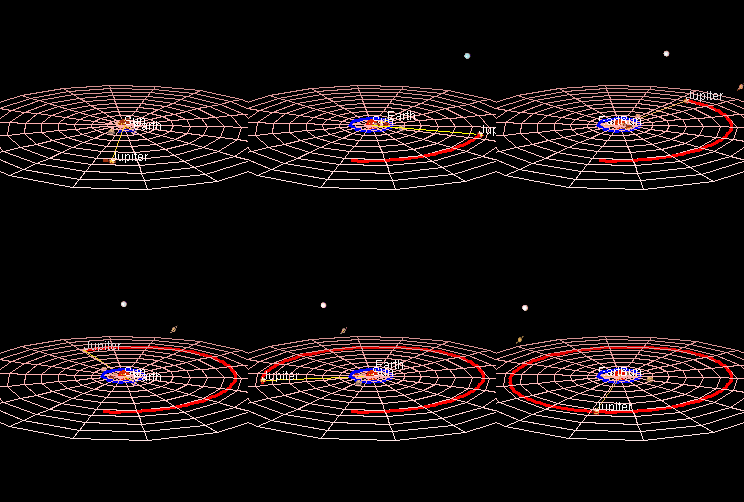
Jupiter orbits the Sun at an average distance of about 778 million kilometers (about 5.2 AU), and completes an orbit every 11.86 years. Jupiter is the only planet that has a center of mass with the Sun that lies outside the volume of the Sun, though by only 7% of the Sun's radius.
www.psrd.hawaii.edu
Planetary Science Research Discoveries (PSRD) is an educational site sharing the latest research by NASA-sponsored scientists on meteorites, asteroids, planets, moons, and other materials in our Solar System. The website is supported by the Cosmochemistry Program of NASA's Science Mission Directorat and by Hawai'i Space Grant Consortium and is a vital link for planetary and space sciences, and for learning how science works.
| The Galilean moons, compared to Earth's Moon | |||||||||
|---|---|---|---|---|---|---|---|---|---|
| Name | IPA | Diameter | Mass | Orbital radius | Orbital period | ||||
| km | % | kg | % | km | % | days | % | ||
| Io | ˈaɪ.oʊ | 3643 | 105 | 8.9×10²² | 120 | 421,700 | 110 | 1.77 | 7 |
| Europa | jʊˈroʊpə | 3122 | 90 | 4.8×10²² | 65 | 671,034 | 175 | 3.55 | 13 |
| Ganymede | ˈɡænimiːd | 5262 | 150 | 14.8×10²² | 200 | 1,070,412 | 280 | 7.15 | 26 |
| Callisto | kəˈlɪstoʊ | 4821 | 140 | 10.8×10²² | 150 | 1,882,709 | 490 | 16.69 | 61 |

A Singapore physics teacher's blog to reach out globally by using Easy Java Simulation (Ejs) applets and other technology innovations in education and learning. What is shared in this blog is created in my free time and each resource is usually created by other Physics educators & professors.

photojournal.jpl.nasa.gov. This dramatic view of Jupiter's Great Red Spot and its surroundings was obtained by Voyager 1 on Feb. 25, 1979, when the spacecraft was 5.7 million miles (9.2 million kilometers) from Jupiter. Cloud details as small as 100 miles (160 kilometers) across can be seen here. The colorful, wavy cloud pattern to the left of the Red Spot is a region of extraordinarily complex end variable wave motion. The Jet Propulsion Laboratory manages the Voyager mission for NASA's Office of Space Science.
Orbital characteristics
Aphelion 816,520,800 km (5.458104 AU)
Perihelion 740,573,600 km (4.950429 AU)
Semi-major axis 778,547,200 km (5.204267 AU)
Eccentricity 0.048775
Orbital period 4,331.572 days
11.85920 yr
10,475.8 Jupiter solar days
Synodic period 398.88 days
Average orbital speed 13.07 km/s
Mean anomaly 18.818°
Inclination 1.305° to Ecliptic
6.09° to Sun's equator
0.32° to Invariable plane
Longitude of ascending node 100.492°
Argument of perihelion 275.066°
Satellites 64
Physical characteristics
Mean radius 69,911 ± 6 km
Equatorial radius 71,492 ± 4 km 11.209 EarthsPolar radius 66,854 ± 10 km 10.517 Earths
Flattening 0.06487 ± 0.00015
Surface area 6.1419×10¹⁰ km2 121.9 Earths
Volume 1.4313×10¹⁵ km3 1321.3 Earths
Mass 1.8986×1027 kg 317.8 Earths 1/1047 SunMean density 1.326 g/cm3Equatorial surface gravity 24.79 m/s2 2.528 gEscape velocity 59.5 km/sSidereal rotationperiod 9.925 h (9 h 55 m 30 s)Equatorial rotation velocity 12.6 km/s 45,300 km/hAxial tilt 3.13°
North pole right ascension 268.057° 17 h 52 min 14 sNorth pole declination 64.496° Albedo 0.343 (Bond) 0.52 (geom.) Surface temp. 1 bar level 0.1 bar min mean max 165 K 112 K Apparent magnitude -1.6 to -2.94 Angular diameter 29.8" — 50.1" AtmosphereSurface pressure 20–200 kPa (cloud layer)Scale height 27 kmComposition 89.8±2.0% Hydrogen (H2)10.2±2.0% Helium~0.3% Methane~0.026% Ammonia~0.003% Hydrogen deuteride (HD)0.0006% Ethane0.0004% waterIces: Ammonia water ammonium hydrosulfide(NH4SH)
Orbital characteristics
Aphelion 816,520,800 km (5.458104 AU)
Perihelion 740,573,600 km (4.950429 AU)
Semi-major axis 778,547,200 km (5.204267 AU)
Eccentricity 0.048775
Orbital period 4,331.572 days
11.85920 yr
10,475.8 Jupiter solar days
Synodic period 398.88 days
Average orbital speed 13.07 km/s
Mean anomaly 18.818°
Inclination 1.305° to Ecliptic
6.09° to Sun's equator
0.32° to Invariable plane
Longitude of ascending node 100.492°
Argument of perihelion 275.066°
Satellites 64
Physical characteristics
Mean radius 69,911 ± 6 km
Equatorial radius 71,492 ± 4 km
11.209 Earths
Polar radius 66,854 ± 10 km
10.517 Earths
Flattening 0.06487 ± 0.00015
Surface area 6.1419×10¹⁰ km2
121.9 Earths
Volume 1.4313×10¹⁵ km3
1321.3 Earths
Mass 1.8986×1027 kg
317.8 Earths
1/1047 Sun
Mean density 1.326 g/cm3
Equatorial surface gravity 24.79 m/s2
2.528 g
Escape velocity 59.5 km/s
Sidereal rotation
period 9.925 h (9 h 55 m 30 s)
Equatorial rotation velocity 12.6 km/s
45,300 km/h
Axial tilt 3.13°
North pole right ascension 268.057°
17 h 52 min 14 s
North pole declination 64.496°
Albedo 0.343 (Bond)
0.52 (geom.)
Surface temp.
1 bar level
0.1 bar
min mean max
165 K
112 K
Apparent magnitude -1.6 to -2.94
Angular diameter 29.8" — 50.1"
Atmosphere
Surface pressure 20–200 kPa (cloud layer)
Scale height 27 km
Composition
89.8±2.0% Hydrogen (H2)
10.2±2.0% Helium
~0.3% Methane
~0.026% Ammonia
~0.003% Hydrogen deuteride (HD)
0.0006% Ethane
0.0004% water
Ices:
Ammonia
water
ammonium hydrosulfide(NH4SH)
The inner moons follow circular orbits around Jupiter interior to Io's orbit. They orbit in Jupiter's equatorial plane.

The inner moons follow circular orbits around Jupiter interior to Io's orbit. They orbit in Jupiter's equatorial plane.
Los Angeles Times

www.latimes.com
The NASA spacecraft Juno, en route to an unprecedented exploration of Jupiter and the origins of the solar system, lifted off this morning from Cape Canaveral in Florida .


www.telegraph.co.uk
Nasa spacecraft "Juno" is launched at 11:25 a.m local time (5.25pm BST) on a mission to Jupiter.

en.rian.ru
The sun-powered unmanned probe Juno set off on Friday on a five-year cruise to Jupiter to explore the secrets of the Solar System formation through scrutinizing the biggest planet, NASA said.

www.ibtimes.com
NASA launched spacecraft Juno for its Jupiter mission at 12:25 p.m. ET on Friday.

www.bbc.co.uk
Nasa's $1.1bn solar-powered Juno mission launches from Florida in a bid to unlock the secrets of the Solar System's largest planet.

www.nationaljournal.com
Images taken of sunlit craters on Mars seem to show water seeping from bedrock and flowing down before evaporating, U.S. researchers reported on Thursday. It is the first time water has been seen in motion on the dry, frozen planet and provides the strongest hint yet that life could exist there.

www.thehindu.com
It’s known that there are frozen water deposits on Mars. Now, it seems that there are seasonal streams of liquid water flowing across the surface of the Red Planet, say astronomers, including an Indian-origin scientist.

news.bbc.co.uk

www.vias.org Voyager 1 took this photo of the planet Jupiter on Jan. 24, while still more than 25 million miles (40 million kilometers) away. As the spacecraft draws closer to the planet (about 1 million kilometers a day) more details are emerging in the turbulent clouds.
www.cafeastrology.com
Cafe Astrology: meaning of and interpretation of Mars conjunct, sextile, trine, square, and opposition Jupiter.
A transit of Mars across the Sun as seen from Jupiter takes place when the planet Mars passes directly between the Sun and Jupiter, obscuring a small part of the Sun's disc for an observer on Jupiter.
During a transit, Mars can be seen from Jupiter as a small black disc moving across the face of the Sun. No one has ever seen a transit of Mars from Jupiter, nor is this likely to happen in any foreseeable future. The next one will take place on July 8, 2040.
A transit of Mars across the Sun as seen from Jupiter takes place when the planet Mars passes directly between the Sun and Jupiter, obscuring a small part of the Sun's disc for an observer on Jupiter.
During a transit, Mars can be seen from Jupiter as a small black disc moving across the face of the Sun. No one has ever seen a transit of Mars from Jupiter, nor is this likely to happen in any foreseeable future. The next one will take place on July 8, 2040.
From empirical observations of transit dates, it appears that transits sometimes repeat after 13062.8 days (about 35 years and 9 months). This corresponds to 15.998 Mars-Jupiter synodic periods, or 19.01 Mars orbital periods, or 3.01 Jupiter orbital periods. However, in many cases, the transit does not repeat because the second event is a near-miss instead.
space.jpl.nasa.gov
Transit of Mars from Jupiter
A transit of Mars across the Sun as seen from Jupiter takes place when the planet Mars passes directly between the Sun and Jupiter, obscuring a small part of the Sun's disc for an observer on Jupiter.
During a transit, Mars can be seen from Jupiter as a small black disc moving across the face of the Sun. No one has ever seen a transit of Mars from Jupiter, nor is this likely to happen in any foreseeable future. The next one will take place on July 8, 2040.
A transit of Mars across the Sun as seen from Jupiter takes place when the planet Mars passes directly between the Sun and Jupiter, obscuring a small part of the Sun's disc for an observer on Jupiter.
During a transit, Mars can be seen from Jupiter as a small black disc moving across the face of the Sun. No one has ever seen a transit of Mars from Jupiter, nor is this likely to happen in any foreseeable future. The next one will take place on July 8, 2040.
From empirical observations of transit dates, it appears that transits sometimes repeat after 13062.8 days (about 35 years and 9 months). This corresponds to 15.998 Mars-Jupiter synodic periods, or 19.01 Mars orbital periods, or 3.01 Jupiter orbital periods. However, in many cases, the transit does not repeat because the second event is a near-miss instead.
| Transits of Mars from Jupiter |
|---|
| July 29, 1613 |
| May 18, 1631 |
| January 17, 1732 |
| November 7, 1749 |
| October 24, 1767 |
| August 12, 1785 |
| April 13, 1886 |
| February 3, 1904 |
| January 19, 1922 |
| November 8, 1939 |
| July 8, 2040 |
| April 28, 2058 |
| February 1, 2094 |
| December 26, 2158 |
| October 2, 2194 |
| July 24, 2212 |
| March 23, 2313 |
| January 14, 2331 |
| December 28, 2348 |
| October 19, 2366 |
| June 17, 2467 |
space.jpl.nasa.gov


www.space.com
The planets Mercury, Venus, Mars and Jupiter will converge in May 2011 in a celestial conjunction in the morning night sky.
In the early days ago, consisting of four planets Mercury, Venus, Mars, and Jupiter had held a "double date". Venus had a date with Jupiter, while Mercury to Mars. Dating from the fourth planet was best seen at 4:00 to 5:00 a.m. in the morning.
Venus and Jupiter were shining brightly, they looked like two supernova. The two planets were separated by only 0.5 degrees, one finger was enough to hide the planet from view. Venus shone at magnitude -3.8 and -2.1 Jupiter.
Mercury had separated two degrees from Venus. While Mars there was a little below the Mercury. Unfortunately, the light of Mercury and Mars wasn't as bright as Venus and Jupiter, it was making more difficult to observe these two planets.
Surely, "double date" the fourth planet could be observed when the sky was clear. According to astronomers, dating all four planets have lasted 5 hours and 38 minutes. Observations during the day might also be done, but it required the tricks, so it didn't disturb the eyes.
The best time for observation itself was at dawn. Observations could be done with the naked eye, with a direct view to the east. Until some time after sunrise, the fourth planet could still be seen.
Well, in May, the planets in our solar system were being happy dating. On 13 May, Mercury, Venus, and Jupiter have formed a triangle. On May 20, the triangle could already be observed, consisting of Mars, Venus, and Mercury.
Interplanetary Dating was the phenomenon of planetary conjunctions. During the month of May, the Jupiter, Mars, Mercury, Venus, Uranus, and Neptune had been almost aligned along the apparent path the Sun. As a final, dated May 30, the five planets had been visible at once.
Very impressive! All of this greatness is the work of almighty creator of Nature.
Venus and Jupiter were shining brightly, they looked like two supernova. The two planets were separated by only 0.5 degrees, one finger was enough to hide the planet from view. Venus shone at magnitude -3.8 and -2.1 Jupiter.
Mercury had separated two degrees from Venus. While Mars there was a little below the Mercury. Unfortunately, the light of Mercury and Mars wasn't as bright as Venus and Jupiter, it was making more difficult to observe these two planets.
Surely, "double date" the fourth planet could be observed when the sky was clear. According to astronomers, dating all four planets have lasted 5 hours and 38 minutes. Observations during the day might also be done, but it required the tricks, so it didn't disturb the eyes.
The best time for observation itself was at dawn. Observations could be done with the naked eye, with a direct view to the east. Until some time after sunrise, the fourth planet could still be seen.
Well, in May, the planets in our solar system were being happy dating. On 13 May, Mercury, Venus, and Jupiter have formed a triangle. On May 20, the triangle could already be observed, consisting of Mars, Venus, and Mercury.
Interplanetary Dating was the phenomenon of planetary conjunctions. During the month of May, the Jupiter, Mars, Mercury, Venus, Uranus, and Neptune had been almost aligned along the apparent path the Sun. As a final, dated May 30, the five planets had been visible at once.
Very impressive! All of this greatness is the work of almighty creator of Nature.
No comments:
Post a Comment